









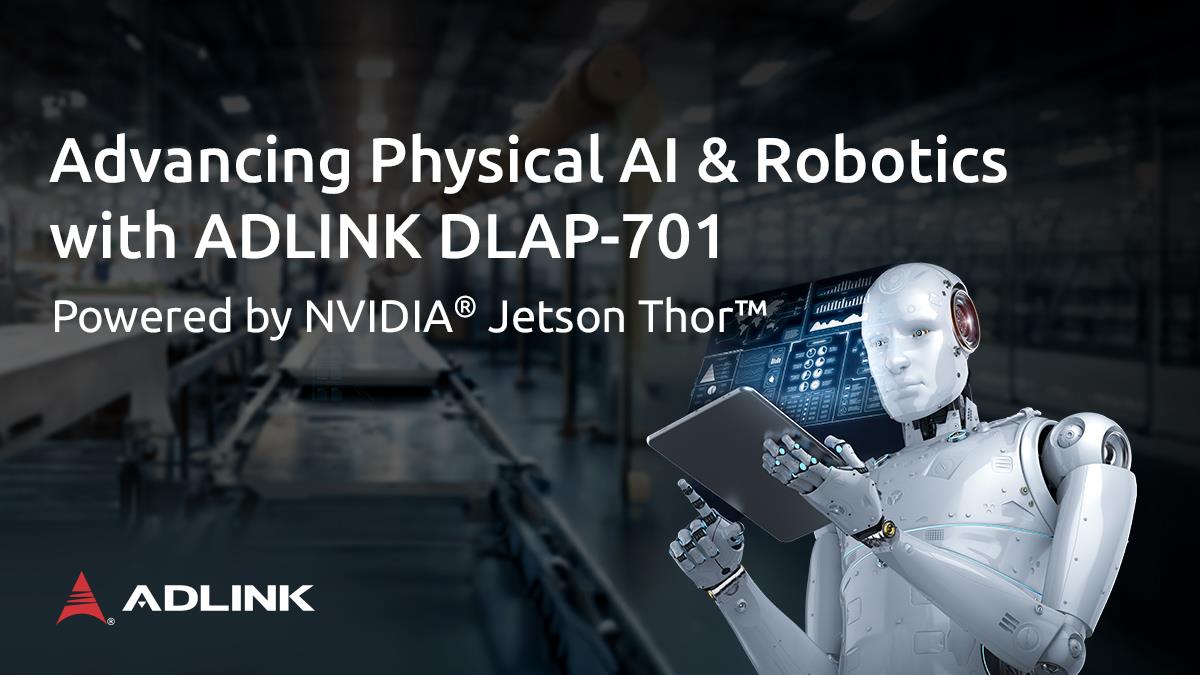
As humanoid robots move beyond research labs, they are now becoming integral to real-world applications, particularly in industrial environments. These environments often contain human movement, tools, and workflows to facilitate task execution. However, many operations still expose workers to safety risks. Humanoid robots are therefore deployed to support workers by handling high-risk tasks that require real-time perception and decision-making in those environments.
This is where the ADLINK DLAP-701 Edge AI platform and NVIDIA Jetson Thor modules come together as an ideal match, combining data-center-class AI performance with industrial-grade design to create a mission-ready foundation built for humanoid robotics.
Intelligent, Real-Time: Edge AI Platform for Humanoids
Over the past decade, automation evolved from fixed industrial robots to mobile autonomous systems capable of navigating dynamic environments. Today, humanoid robots are stepping in to support workers, taking on hazardous tasks while keeping humans out of harm’s way and boosting operational safety and efficiency.
Early humanoid systems struggled with limited computational power, slow perception pipelines, and unreliable hardware under harsh conditions, especially as AI models became more complex with deep learning, multimodal perception, and real-time decision-making.
The ADLINK DLAP-701 Edge AI platform directly addresses these challenges:
- Process massive sensor data streams in real time
- Run advanced perception, planning, and control models simultaneously
- Operate efficiently within strict power budgets
With the DLAP-701, humanoid robots move beyond experimental prototypes into reliable, deployable systems capable of handling hazardous operations across demanding industrial environments.
Choosing the Right AI Compute Engine
Powering ADLINK’s DLAP-701 Edge AI platform are the latest NVIDIA Jetson Thor modules, engineered to handle real-time perception, planning, and control for demanding AI workloads in extreme environments.
NVIDIA Jetson T5000: Maximum Performance for Advanced Humanoids
NVIDIA Jetson T5000 is built for full-scale humanoid robots in highly dynamic, unpredictable environments. It delivers powerful AI compute performance, reaching up to 2070 FP4 TFLOPS, paired with 128 GB of memory, with configurable power ranging from 40 W to 130 W. It enables complex real-time reasoning, manages massive sensor data streams, and runs multiple AI workloads simultaneously.
Key strengths:
- Extreme AI compute for high-demand humanoid behaviors
- Real-time decision-making across multiple sensors and actuators
NVIDIA Jetson T4000: High Efficiency for Scalable Robotics
NVIDIA Jetson T4000 offers a strong balance between performance and power efficiency. It provides up to 1200 FP4 TFLOPS of AI compute with 64 GB of memory, operating within a 40 W to 70 W power envelope. It supports scalable deployments and long-duration autonomous operations.
Key strengths:
- Efficient AI compute for sustained workloads
- Ideal for scenarios with strict power and thermal constraints
Each module delivers the capabilities needed for low-latency perception, precise motion control, and real-time decision-making— core requirements for humanoids and physical AI.
DLAP-701 in Action: Real Robots, Real Heavy Industry Impact
AI performance alone isn’t enough in heavy industry—hardware reliability and seamless system integration are equally critical. The DLAP-701 Edge AI platform is purpose-built to bridge this gap, providing the high-performance computing foundation that real-world robotics demands.
A pioneering robotics firm has turned to ADLINK’s DLAP-701 to bring its AI-driven robotics to life. DLAP-701, built on NVIDIA Jetson Thor, enables humanoid autonomous robots to operate safely and efficiently in some of the harshest industrial environments, including mining sites, construction zones, and energy facilities.
With DLAP-701 at its core, the pioneering robotics firm:
- Process massive sensor data streams in real time, integrating multiple high-resolution cameras, LiDAR, and other high-bandwidth sensors to perceive complex environments.
- Run advanced AI models simultaneously, enabling real-time perception, planning, and control for autonomous navigation and adaptive decision-making.
- Maintain stable, long-duration operations thanks to industrial-grade power management optimized for mobile robots, balancing performance with energy efficiency.
- Operate reliably under extreme conditions, with shock, vibration, dust, and temperature resistance built into the platform.
Driven by DLAP-701, these robots move beyond prototypes into fully deployable solutions, transforming high-risk, physically demanding tasks into automated workflows. By combining rugged industrial design with data-center-class AI compute, DLAP-701 enables the firm to focus on innovation in AI autonomy and control—confident that the underlying hardware can handle the physical realities of heavy industry.
Enabling What Was Once Impossible
The convergence of ADLINK DLAP-701 and NVIDIA Jetson Thor marks a turning point for humanoid robotics in heavy industry. Tasks that were once too critical, too complex, or too unpredictable for automation are now within reach. Real-time perception, adaptive decision-making, and rugged reliability are no longer trade-offs; they coexist in a single, scalable platform.
By delivering exceptional AI performance at the edge and pairing it with industrial-grade system design, this combination transforms humanoid robots and other autonomous systems from experimental machines into dependable industrial partners. What was once impossible, robots operating intelligently and autonomously in the harshest environments, is now not only possible, but ready to scale.
Learn more about NVIDIA-based solutions: click here


