
• 購物車(0)
繁體中文
English
简体中文
한국어
日本語
繁體中文
  • 登錄
  • 產品
    嵌入式模組化電腦
    • COM-HPC
    • COM Express
    • OSM
    • SMARC
    • Qseven
    • ETX
    GPU解決方案
    • MXM GPU 模組
    • PCIe 顯示卡
    強固型運算
    • CompactPCI & CompactPCI Serial
    • VPX
    • PC104
    • AVA Railway Rugged Computers
    • PIDS
    邊緣運算平台
    • 工業電腦 / 主機板 / 單板電腦
    • 嵌入式電腦 / IoT Gateway
    • 邊緣 AI 運算平台
    • AI 智慧相機
    • 機器人控制器
    • 工業級固態硬碟 (SSD)
    工業級顯示系統與平板電腦
    • 工業級觸控顯示器
    • Open Frame 平板電腦
    • All-in-One 平板電腦
    • 強固型面板電腦
    • 數位看板播放器 / 迷你電腦
    網路通訊與伺服器
    • AI GPU 伺服器
    • 工業級邊緣伺服器
    自動化與控制
    • 機器視覺
    • 運動控制與 I/O
    • EtherCAT 運動控制解決方案
    • HMI 平板電腦
    • 資料擷取模組
    • GPIB 與數字化儀
    • PXI 平台與模組
    • 自主移動機器人
    • 工業物聯網閘道器
    設計與製造服務
    • DMS+ (ODM/OEM 服務)
    醫療專用電腦與顯示器
    • 醫療專用觸控電腦
    • 醫療專用顯示器
    • 醫療專用 BOX PC
    軟體
    • EdgeGO
  • 解決方案
    邊緣AI 娛樂資訊 智慧醫療 鐵路 機器人技術 半導體解決方案 智慧製造

    邊緣AI

    邊緣AI

    為分散式智慧運算的新一波浪潮注入動能,凌華科技的邊緣AI解決方案提供完整且可擴展的產品組合,涵蓋各層級邊緣運算需求——從低功耗推論到高負載的大型模型推論,皆能靈活部署。每套系統皆採用 AI 整合式設計,內建支援 GPU/加速器的 I/O 介面,實現真正的隨插即用部署。此架構具備 GenAI-ready 優勢,可為視覺 AI、預測分析及裝置端大型語言模型推論提供最佳化效能,加速智慧應用落地。

    了解更多

    娛樂資訊

    娛樂

    凌華科技博弈平台解決方案透過我們的軟、硬體和顯示產品為全球遊戲機製造商提供全面性的服務。 我們將電腦專業知識與尖端軟體完美結合,並遵循博弈產業的要求和法規限制來為我們客戶提供服務,使他們能夠專注於打造世界上最好的娛樂體驗。

    了解更多

    智慧醫療

    智慧醫療

    凌華科技專注於醫療可視化設備和經過醫療認證的解決方案,來滿足智慧醫療數位化的需求。 透過PENTA在醫療領域的設計和製造能力,凌華科技的智慧醫療解決方案可加速各種醫療環境中的智慧轉型。

    了解更多

    鐵路

    鐵路

    我們的強固設計 CompactPCI、模組化電腦、工業級系統及平板電腦系列產品特別獲選納入車載 ATO/DMI 及軌旁 CTC/RBC/TSR 鐵路解決方案。凌華科技在設計和製造方面的卓越靈活性廣受全球鐵路號誌領導供應商的青睞。

    了解更多

    機器人技術

    機器人技術

    自主移動機器人(AMR)能夠在沒有或最低限度的人工操作監督之下來執行工作。在一些可以使用大量的AMR設施譬如學校、醫院、大型購物中心和工廠之類的,以提高營運效率和生活品質。

    了解更多

    半導體解決方案

    半導體解決方案

    你所能想像的一切,都因晶片而有所改變。為了滿足不同應用的需求,完美的晶圓製造對於品質的工藝要求到效率和生產力的過程都無比講究。

    了解更多

    智慧製造

    智慧製造

    借由邊緣運算,ADLINK 智慧製造解決方案加速更快的數據決策,為半導體和電子製造業創造更具彈性和安全性的生產環境。

    了解更多
  • 策略夥伴
    AMD Ampere Arm Intel MediaTek NVIDIA NXP Qualcomm

    AMD-based Solutions

    AMD-based Solutions by ADLINK

    Empower your edge computing with ADLINK, a leading company enabling edge solutions. Leverage AMD's high performance, secure integration, and power efficiency advantages for a wide range of edge, networking, and edge systems with x86 core architecture. Experience superior processing and graphics performance with ADLINK's utilization of AMD EPYC™ Server CPUs and Ryzen™ Embedded series, powered by EPYC™ 9004/9005 Series CPUs and Radeon™ RX, perfect for industrial, medical, automation and gaming applications.

    Learn More

    Ampere-based Solutions

    Ampere-based Solutions by ADLINK

    Experience the future of edge computing with our comprehensive offering, which includes the Ampere Altra-based COM-HPC module, a developer platform and/or dev kit. Dive in now to unleash superior performance, energy efficiency, and optimized TCO in applications including but not limited to industrial automation, autonomous vehicles, transportation, healthcare, video surveillance, and energy management.

    Learn More

    Arm-based Solutions

    Arm-based Solutions by ADLINK

    Based on Arm architecture, ADLINK also collaborates with Ampere, NXP, MediaTek, Qualcomm, and Rockchip in module computing development and value-added solutions across varied industries, including smart manufacturing, autonomous driving, robotics, AMR, drone, transportation, logistics, retail, infotainment, healthcare, security, and more.

    With plug-and-play tools, development kits, and all-encompassing systems, ADLINK and Arm empowers developers to accelerate and realize their innovations.

    Learn More

    Intel-based Solutions

    Intel based Solutions by ADLINK

    ADLINK is a Prestige Partner of Intel® Partner Alliance. From modular computing to system-ready use cases, ADLINK collaborates closely with Intel to deliver scalable, interoperable solutions that accelerate the deployment of intelligent devices with end-to-end analytics.

    ADLINK leverages Intel® AI Edge Systems to deliver scalable, high-performance AI at the edge. Built on proven, benchmarked edge computing platforms, these solutions integrate GPU and NPU acceleration with enterprise-ready manageability to optimize real-world AI workloads. With long lifecycle support, industrial-grade reliability, and best-in-class TCO, ADLINK and Intel enable faster time-to-market and seamless AI deployment across diverse edge environments.

    Learn More

    MediaTek-based Solutions

    MediaTek-based Solutions by ADLINK

    ADLINK Technology and MediaTek are strategic partners that deliver innovative and powerful solutions for edge computing and edge AI applications. Leveraging MediaTek's flagship, power-efficient Genio platform SoCs and ADLINK's expertise in embedded and rugged designs, they provide high-performance, energy-efficient, and reliable modules and platforms in accomplishing various IoT use cases, such as smart home, human-machine interface, multimedia, industrial IoT, and robotics.

    Learn More

    NVIDIA-based Solutions

    NVIDIA-based Solutions by ADLINK

    To fulfill industry-specific requirements, ADLINK is able to efficiently develop edge AI platforms, AI smart cameras, medical platforms, and AI portable GPU accelerators based on NVIDIA Jetson modules, the NVIDIA IGX platform, and RTX Embedded GPUs for applicable industries, including smart manufacturing, autonomous driving, autonomous mobile robots (AMR), robotics, transportation, healthcare, logistics, retail, infotainment, AI development, professional graphics, and gaming.

    Learn More

    NXP-based Solutions

    NXP-based Solutions by ADLINK

    Utilizing NXP's i.MX 8 and i.MX 9 series technology, ADLINK offers edge-connected solutions to assist medical, test & measurement, automation, and smart city customers reduce TCO. This combination of NXP's technology with ADLINK's R&D experience in edge computing provides versatile and dynamic solutions for critical applications.

    Learn More

    Qualcomm-based Solutions

    Qualcomm-based Solutions by ADLINK

    Qualcomm Technologies’ portfolio of leading robotics and drones solutions is driving next-generation use cases, including autonomous deliveries, mission critical use cases, commercial and enterprise drone applications and more.

    Among them, the Qualcomm QRB5165 solution is designed to help build consumer, enterprise or industrial robots with 5G connectivity, on-device AI and machine learning, superior computing, and intelligent sensing capabilities. By adopting Qualcomm QRB5165, ADLINK’s module will enable the proliferation of 5G in robotics and intelligent systems.

    Learn More
    EdgeOpen Voices

    EdgeOpen™ Voices

    了解業界專家如何透過實際案例與實務洞察推動邊緣 AI 發展。

    立即查看
  • 支援

    支援

    夥伴中心eRMA 服務凌華科技 DDS 支援

    下載

    軟體與驅動程式下載凌華科技 DDS宣傳手冊Content Hub凌華科技 GitHub

    聯絡我們

    銷售諮詢諮詢技術專家全球經銷商

    若您有任何價格、產品庫存問題,或需要任何技術上的協助,歡迎隨時與我們連繫。

    了解更多
  • 關於我們

    價值

    品質政策與資源合作夥伴企業永續環境責任政策Capabilites

    公司

    關於凌華全球據點投資人關係公司簡介企業logo與品牌規範人才招募

    新聞

    新聞與活動部落格EdgeOpen™ Podcast
    Support

    公司新聞、產品資訊、近期活動或技術部落格,一手掌握ADLINK的最新資訊。

    了解更多
  • 首頁
  • 應用故事
  • UGV Requirements Push Evolution in HPEC Performance
  • 首頁
  • 應用故事
  • UGV Requirements Push Evolution in HPEC Performance
繁體中文
English
简体中文
한국어
日本語
繁體中文
  • 登錄
  • 登錄
  • home
    • 產品
      嵌入式模組化電腦+ GPU解決方案+ 強固型運算+ 邊緣運算平台+ 工業級顯示系統與平板電腦+ 網路通訊與伺服器+ 自動化與控制+ 設計與製造服務+ 醫療專用電腦與顯示器+ 軟體+
      COM-HPCCOM ExpressOSMSMARCQsevenETX
      MXM GPU 模組PCIe 顯示卡
      CompactPCI & CompactPCI SerialVPXPC104AVA Railway Rugged ComputersPIDS
      工業電腦 / 主機板 / 單板電腦嵌入式電腦 / IoT Gateway邊緣 AI 運算平台AI 智慧相機機器人控制器工業級固態硬碟 (SSD)
      工業級觸控顯示器Open Frame 平板電腦All-in-One 平板電腦強固型面板電腦數位看板播放器 / 迷你電腦
      自動駕駛解決方案AI-ADAS 解決方案
      AI GPU 伺服器工業級邊緣伺服器
      機器視覺運動控制與 I/OEtherCAT 運動控制解決方案HMI 平板電腦資料擷取模組GPIB 與數字化儀PXI 平台與模組自主移動機器人工業物聯網閘道器
      DMS+ (ODM/OEM 服務)
      醫療專用觸控電腦醫療專用顯示器醫療專用 BOX PC
      EdgeGO
      AdvancedTCA 交換器AdvancedTCA 平台AdvancedTCA 刀鋒伺服器
      嵌入式固態硬碟
      COM-HPC Server Type COM-HPC Client Type
      COM Express Type 6 COM Express Type 7 COM Express Type 10 COM Express Type 2
      MXM 3.1 Type A MXM 3.1 Type B
      Pocket AI (可攜式GPU)
      3U VPX 刀鋒伺服器 6U VPX 刀鋒伺服器 VPX 顯示卡, XMC模組
      Mini-ITX 嵌入式主機板 可擴充式無風扇電腦 嵌入式無風扇電腦 ATX 主機板 嵌入式板卡 工業電腦系統 PICMG 單板電腦 無電源背板 工業電腦周邊 工業電腦機箱
      搭載NVIDIA Jetson系列
      ROS2 解决方案 凌華科技ROS2 Github NeuronSDK
      圖像擷取卡/視頻擷取卡 影像分析工具 智慧相機 視覺系統 人工智慧機器視覺設備
      集中式運動控制器 分散式運動控制器 編碼器和觸發器 運動控制軟體和工具
      設備狀態監測與維護平台 資料擷取模組 數字化儀 / 示波器
      PXI 機箱 PXI 控制器 PXI/PXIe 模組 遠端控制器
      AMR
    • 解決方案
      邊緣AI 娛樂資訊 智慧醫療 鐵路 機器人技術 半導體解決方案 智慧製造

      邊緣AI

      邊緣AI

      為分散式智慧運算的新一波浪潮注入動能,凌華科技的邊緣AI解決方案提供完整且可擴展的產品組合,涵蓋各層級邊緣運算需求——從低功耗推論到高負載的大型模型推論,皆能靈活部署。每套系統皆採用 AI 整合式設計,內建支援 GPU/加速器的 I/O 介面,實現真正的隨插即用部署。此架構具備 GenAI-ready 優勢,可為視覺 AI、預測分析及裝置端大型語言模型推論提供最佳化效能,加速智慧應用落地。

      了解更多

      娛樂資訊

      娛樂

      凌華科技博弈平台解決方案透過我們的軟、硬體和顯示產品為全球遊戲機製造商提供全面性的服務。 我們將電腦專業知識與尖端軟體完美結合,並遵循博弈產業的要求和法規限制來為我們客戶提供服務,使他們能夠專注於打造世界上最好的娛樂體驗。

      了解更多

      智慧醫療

      智慧醫療

      凌華科技專注於醫療可視化設備和經過醫療認證的解決方案,來滿足智慧醫療數位化的需求。 透過PENTA在醫療領域的設計和製造能力,凌華科技的智慧醫療解決方案可加速各種醫療環境中的智慧轉型。

      了解更多

      鐵路

      鐵路

      我們的強固設計 CompactPCI、模組化電腦、工業級系統及平板電腦系列產品特別獲選納入車載 ATO/DMI 及軌旁 CTC/RBC/TSR 鐵路解決方案。凌華科技在設計和製造方面的卓越靈活性廣受全球鐵路號誌領導供應商的青睞。

      了解更多

      機器人技術

      機器人技術

      自主移動機器人(AMR)能夠在沒有或最低限度的人工操作監督之下來執行工作。在一些可以使用大量的AMR設施譬如學校、醫院、大型購物中心和工廠之類的,以提高營運效率和生活品質。

      了解更多

      半導體解決方案

      半導體解決方案

      你所能想像的一切,都因晶片而有所改變。為了滿足不同應用的需求,完美的晶圓製造對於品質的工藝要求到效率和生產力的過程都無比講究。

      了解更多

      智慧製造

      智慧製造

      借由邊緣運算,ADLINK 智慧製造解決方案加速更快的數據決策,為半導體和電子製造業創造更具彈性和安全性的生產環境。

      了解更多
    • 策略夥伴
      AMD Ampere Arm Intel MediaTek NVIDIA NXP Qualcomm

      AMD-based Solutions

      AMD-based Solutions by ADLINK

      Empower your edge computing with ADLINK, a leading company enabling edge solutions. Leverage AMD's high performance, secure integration, and power efficiency advantages for a wide range of edge, networking, and edge systems with x86 core architecture. Experience superior processing and graphics performance with ADLINK's utilization of AMD EPYC™ Server CPUs and Ryzen™ Embedded series, powered by EPYC™ 9004/9005 Series CPUs and Radeon™ RX, perfect for industrial, medical, automation and gaming applications.

      Learn More

      Ampere-based Solutions

      Ampere-based Solutions by ADLINK

      Experience the future of edge computing with our comprehensive offering, which includes the Ampere Altra-based COM-HPC module, a developer platform and/or dev kit. Dive in now to unleash superior performance, energy efficiency, and optimized TCO in applications including but not limited to industrial automation, autonomous vehicles, transportation, healthcare, video surveillance, and energy management.

      Learn More

      Arm-based Solutions

      Arm-based Solutions by ADLINK

      Based on Arm architecture, ADLINK also collaborates with Ampere, NXP, MediaTek, Qualcomm, and Rockchip in module computing development and value-added solutions across varied industries, including smart manufacturing, autonomous driving, robotics, AMR, drone, transportation, logistics, retail, infotainment, healthcare, security, and more.

      With plug-and-play tools, development kits, and all-encompassing systems, ADLINK and Arm empowers developers to accelerate and realize their innovations.

      Learn More

      Intel-based Solutions

      Intel based Solutions by ADLINK

      ADLINK is a Prestige Partner of Intel® Partner Alliance. From modular computing to system-ready use cases, ADLINK collaborates closely with Intel to deliver scalable, interoperable solutions that accelerate the deployment of intelligent devices with end-to-end analytics.

      ADLINK leverages Intel® AI Edge Systems to deliver scalable, high-performance AI at the edge. Built on proven, benchmarked edge computing platforms, these solutions integrate GPU and NPU acceleration with enterprise-ready manageability to optimize real-world AI workloads. With long lifecycle support, industrial-grade reliability, and best-in-class TCO, ADLINK and Intel enable faster time-to-market and seamless AI deployment across diverse edge environments.

      Learn More

      MediaTek-based Solutions

      MediaTek-based Solutions by ADLINK

      ADLINK Technology and MediaTek are strategic partners that deliver innovative and powerful solutions for edge computing and edge AI applications. Leveraging MediaTek's flagship, power-efficient Genio platform SoCs and ADLINK's expertise in embedded and rugged designs, they provide high-performance, energy-efficient, and reliable modules and platforms in accomplishing various IoT use cases, such as smart home, human-machine interface, multimedia, industrial IoT, and robotics.

      Learn More

      NVIDIA-based Solutions

      NVIDIA-based Solutions by ADLINK

      To fulfill industry-specific requirements, ADLINK is able to efficiently develop edge AI platforms, AI smart cameras, medical platforms, and AI portable GPU accelerators based on NVIDIA Jetson modules, the NVIDIA IGX platform, and RTX Embedded GPUs for applicable industries, including smart manufacturing, autonomous driving, autonomous mobile robots (AMR), robotics, transportation, healthcare, logistics, retail, infotainment, AI development, professional graphics, and gaming.

      Learn More

      NXP-based Solutions

      NXP-based Solutions by ADLINK

      Utilizing NXP's i.MX 8 and i.MX 9 series technology, ADLINK offers edge-connected solutions to assist medical, test & measurement, automation, and smart city customers reduce TCO. This combination of NXP's technology with ADLINK's R&D experience in edge computing provides versatile and dynamic solutions for critical applications.

      Learn More

      Qualcomm-based Solutions

      Qualcomm-based Solutions by ADLINK

      Qualcomm Technologies’ portfolio of leading robotics and drones solutions is driving next-generation use cases, including autonomous deliveries, mission critical use cases, commercial and enterprise drone applications and more.

      Among them, the Qualcomm QRB5165 solution is designed to help build consumer, enterprise or industrial robots with 5G connectivity, on-device AI and machine learning, superior computing, and intelligent sensing capabilities. By adopting Qualcomm QRB5165, ADLINK’s module will enable the proliferation of 5G in robotics and intelligent systems.

      Learn More
      EdgeOpen Voices

      EdgeOpen™ Voices

      了解業界專家如何透過實際案例與實務洞察推動邊緣 AI 發展。

      立即查看
    • 支援

      支援

      夥伴中心eRMA 服務凌華科技 DDS 支援

      下載

      軟體與驅動程式下載凌華科技 DDS宣傳手冊Content Hub凌華科技 GitHub

      聯絡我們

      銷售諮詢諮詢技術專家全球經銷商

      若您有任何價格、產品庫存問題,或需要任何技術上的協助,歡迎隨時與我們連繫。

      了解更多
    • 關於我們

      價值

      品質政策與資源合作夥伴企業永續環境責任政策Capabilites

      公司

      關於凌華全球據點投資人關係公司簡介企業logo與品牌規範人才招募

      新聞

      新聞與活動部落格EdgeOpen™ Podcast
      Support

      公司新聞、產品資訊、近期活動或技術部落格,一手掌握ADLINK的最新資訊。

      了解更多
繁體中文
English
简体中文
한국어
日本語
繁體中文
  • 登錄

UGV Requirements Push Evolution in HPEC Performance

Mike Jones, Rugged Systems Product Manager
ADLINK Technology Inc.

Link
UGV Requirements Push Evolution in HPEC Performance

As modern warfare changes, so must the technical innovations from global defense sector technology partners. The changing face of military engagements, fewer troops on the ground, more use of reconnaissance gathered via autonomous vehicles, real-time feeds to operations and the emergence of network-centric warfare are driving the solutions and applications needed to better support today's warfighter.


At their core, today's battlefield engagements depend on access to and the ability to share complex, real-time data with battlefield commanders, who in turn can push select information all the way down to the front-line warfighter. As warfare adjusts to incorporate more types of autonomous vehicles, including those discussed in the Unmanned Ground Systems Roadmap1 developed by the US Army's Robotics Systems Joint Project Office (RS JPO), the need to further reduce SWaP—most-effectively through a standards-based footprint—while also providing High Performance Embedded Computing (HPEC) with flexible sensor I/O, will once again demand a quantum leap in engineering innovation.


The support of autonomous ground mobile computing requirements for vehicle operating functions such as vision, communications and autonomous navigation, in parallel with support for payload functions such as custom sensor input or weapons management, will place a high burden on the current crop of rugged HPEC offerings. Will the answer be more custom-fit proprietary solutions, a mix of smaller dedicated processors or the evolution of standards to meet the needs of an autonomous vehicle future? The optimistic answer is that the evolution of technology standards, COTS and engineering innovation will be help usher in the age of vehicle autonomy in all forms of military engagements.

Real World Robotic Systems JPO Drives the Roadmap


Today's UGVs are either tele-operated by a remote human driver, or run semi-autonomously. At this stage of UGV development, there is a range of capability for autonomous operation. For example, the UGV can either be slaved to another human-operated vehicle in a convoy scenario, or follow a tracking beacon or geographic waypoints using onboard sensors, GPS and computing power to guide progress. HPEC can play a big role in the evolution of autonomous capabilities as they head toward full independence. In addition, the needs of payloads, such as Improvised Explosive Detection (IED) devices, will become ever more sophisticated. Autonomous operation will need situational awareness provided by payload computing as UGVs become fully autonomous.


To support progress toward full autonomy, the US Army's RS JPO has developed a functional plan for multiple types of UGVs, including multiple classes of vehicles and unmanned ground vehicle platforms. Specifically, the classes known as self-transportable and appliqué will have the most influence over the HPEC evolution.


The RS JPO's Unmanned Ground Systems Roadmap was created with key technology enablers for UGV growth over time. Some of these enablers will have a unique evolutionary/revolutionary HPEC requirement, especially as applied to the sub-segments of autonomous navigation, power, vision, architecture and payload support. To support this roadmap, HPEC solutions will soon require performance upgrades beyond what is available today. Within the UGV self-transportable and appliqué classes there are specific programs with unique capability sets, that require technology enablers in order to adhere to the roadmap. These programs include:

 
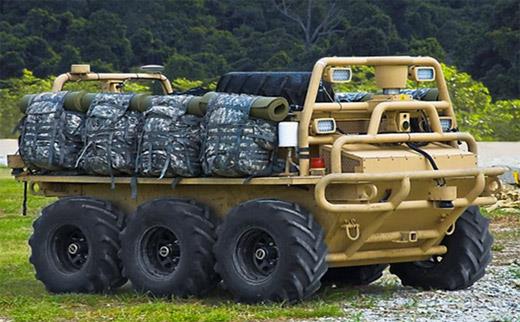
  • Project Workhorse: UGV program deploying in Afghanistan that involves a self-transportable utility platform in the form of the Army sponsored Squad Mission Support System (SMSS) from Lockheed Martin. The SMSS is an autonomous ground vehicle that can carry up to a half-ton of squad equipment and can be remotely operated via satellite to perform autonomous operations such as follow-me, go-to-point and retro-traverse. The SMSS sensor suite integrates Light Detection And Ranging (LIDAR), infrared (IR) and a color camera. The vehicle can lock-on and follow any person by identifying his 3D profile captured by the onboard sensors. The SMSS can autonomously navigate through a pre-programmed route using GPS waypoints. Evolution of this class of UGV will require improvements in onboard computer power consumption and more and better sensor integration, while also providing equal or higher computes with a reduced detectable emission signature (See Figure 1).

Figure 1. Lockheed Martin's SMSS, currently deployed in Afghanistan.

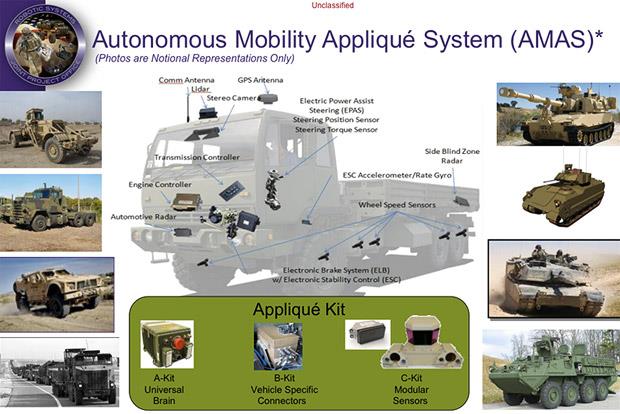
  • Convoy Active Safety Technology (CAST): Autonomous Mobility Applique System (AMAS) in the form of an add-on or appliqué retrofit kit to virtually any existing manned vehicle, permitting a wide range of autonomous behavior. Capabilities range from remote operation to driver assist to fully autonomous driving and navigation. The AMAS will be produced using a common open architecture and delivered in multi-kit form: an “A-Kit,” which is the universal brain; a “B-Kit,” which contains the vehicle-specific sensors, aggregation and connectors; and the “C-Kit,” which is oriented toward payload management. With the AMAS, more processing means more autonomous capability; to meet the scale of expected demand, the kits should be delivered in a smaller, standard footprint and take advantage of standardized connections, lowering system costs (See Figure 2).

Figure 2. Examples of how the AMAS kits can be used in a variety of military vehicles to promote varying levels of autonomy.

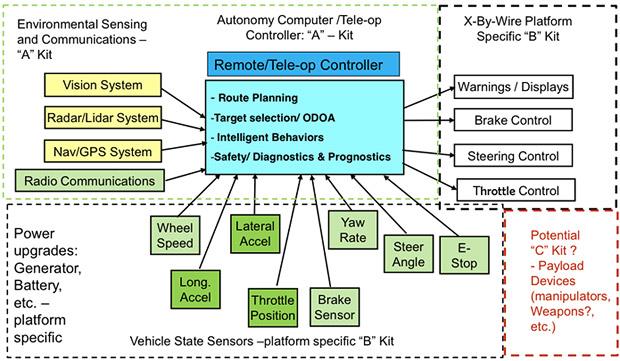
A common need across programs is the function of autonomous operation and payload support. For the AMAS technology illustrated in Figure 3, autonomous operation is achieved using a combination of multiple sensors, onboard processing, drive-by-wire functionality and additional payload control.

While these programs are currently underway, the Army's RS JPO technology roadmap demands enhanced capabilities for future revisions of these programs that support the following:

 
  • Integration of higher definition IR cameras, more onboard image enhancement for visible spectrum cameras, future integration of both visible and IR data in real time, more camera/sensor inputs that can support higher bandwidth.
  • Algorithm support for object detection and avoidance, intelligent object detection and tracking, stereographic imaging and processing (eventually reaching object identification).
  • HPEC computing support for the above, along with integration of multi-sensor payloads such as IED detection, weapons management, manipulators and sensor cross-cueing.
  • Future common, standards-based architecture for UGV computing (per the RS JPO and its Interoperability Initiative - currently at IOP v.0).
 

For UGVs to achieve improved autonomous operation, the technology roadmap calls for progress in sensor capabilities in terms of input speed, multiple sensor data aggregation, real-time data processing and results dissemination to the controller subsystems. With the sensor requirements and payload-specific support, such as side-looking radar for IED detection, the demand on a single HPEC solution is great. In addition, the push for open standards across the entire scope of product architecture will drive adoption of less proprietary physical hardware, connectivity and software solutions, thus creating the potential for more competitive, interchangeable and evolutionary options.

Imaging and Payload Technology Drives HPEC Requirements in UGVs


Computing requirements in UGVs are being driven by imaging used in support of machine vision and the advent of complex payloads for IED detection. There are military UGV programs that need an ability to perform autonomous navigation during the day, as well as the night. They require the ability to navigate in stealth mode (where perception sensor energy is not emitted). Using a pair of Thermal Infrared (TIR) cameras, stereo ranging and terrain classification can be performed to generate an annotated map of the terrain. TIR is a convenient option, since a single TIR camera may already be a part of the sensor suite of many vehicles. A HPEC is provided to analyze the thermal image data and perform the terrain mapping2.


For the evolution of autonomous operation relying on TIR offered in UGVs, the image processing that is critical to control functions like autonomous navigation will need to increase as the sensor data streams increase. To achieve useful machine vision, a camera sensor fusion will likely include IR, color CCD and LIDAR capability in a single turret3. Each of these cameras will operate between 15 to 60 fps and can today generate uncompressed 516 Mbits/second of image data per camera, growing to 1.3 Gbits/second and finally 3.48 Gbits/second. Camera data might not be compressed at the source, so as not to degrade the level of image processing that can be rendered by the HPEC interfaced using the RS-170 or RS-422 video signal standard. As data rates increase, CameraLink, GigEVision or CoaXpress will replace the above interfaces.


The RS JPO roadmap calls for new obstacle and collision avoidance algorithms, which rely heavily on recursive calculations best done on GP-GPUs or specialized FPGAs. For example, recent research done for UAV image processing using GP-GPU based algorithms4 has shown a 99.5% increase in performance over running the same algorithm on an Intel CPU. In all cases, the GP-GPU rendered the results in under 50 msec4. Given a fully autonomous vehicle scenario where a human operator is not involved, and vehicle operation decisions must be made in real-time at speed; having an HPEC equipped with GP-GPU capability that can correlate all the inputs and successfully execute the mission is imperative. Hence the use of multiple types of higher definition cameras running at a higher resolution; higher bandwidth will drive the design of rugged HPEC computing that supports future UGVs.


A complete anti-IED payload system requires an IED-detection component, an IED-assessment component and an IED-defeat component. The payload processing must be accomplished in real-time to achieve the desired level of safety for the UGV and its mission. As with autonomous navigation and machine vision, the real-time detection of the changes in the data coming from the detector components will require a large amount of either GP-GPU or FPGA processing.


Today, a divide and conquer approach is used to separate vehicle control, sensors and payload processing. Separating functions into kits as described with AMAS technology (See Figure 4) is a good approach to the future growth of HPEC in UGVs. For example, a fully autonomous vehicle with a payload of ground penetrating radar could not execute all of its processing tasks with a single HPEC solution. By sub-dividing the problem into compute and function nodes, a scalable long-term solution emerges. Having standards for the UGV solutions that regularize the HPEC physical box size, supported I/O and connector types will enable interchangeability and evolution as HPEC solutions grow and change.

Evolution of Technology Standards, COTS and Engineering Innovation


Evolving UGV requirements need raw processing speed and execute algorithms that are highly recursive, creating the need to have HPEC solutions that combine generic COTS Intel CPU processing and a closely coupled GP-GPU into a single solution.


As mentioned, the RS JPO is promoting the use of standards in the fielding of UGV solutions, current market 3U & 6U VPX provide rugged HPEC solutions. Emerging standards in smaller footprint HPEC solutions include the VITA Technologies standard known as VITA 75. VITA 75 takes a fundamentally different approach from other small form factor standards, in that it concentrates on the physical box, a set of standard enclosures dimensions, connectors and I/O pin assignments, rather than on specifying the individual computer modules inside.


VITA 75 subsystem profiles are composed of up to four separate sub-profiles:

 
  • VITA 75.0 component of subsystem profile (base profile)
  • VITA 75.11 component of subsystem profile (front panel profile)
  • VITA 75.2x cooling and mounting, consisting of a VITA 75.2x dot specification followed by profile nomenclature specified by VITA 75.2x
 

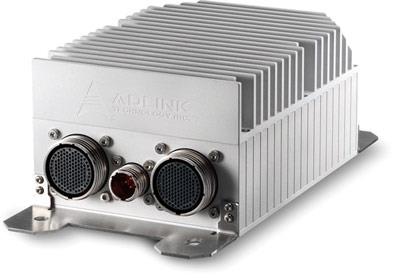
VITA 75 solutions are especially well-suited to address UGV HPEC requirements, as they provide designers with a set of standardized footprints that are generally smaller than equivalently equipped OpenVPX 3U or 6U solutions, while also offering a standardized connector scheme that allows for sub-system interchangeability at the vehicle-level and provides for evolution of the vehicles sub-system in a predictable fashion. ADLINK's HPERC (High Performance Extreme Rugged Computer) system is typical of this type of VITA 75 solution (See Figure 5). HPERC provides a solid foundation of Intel i7 processing closely coupled to either an embedded NVIDIA or ATI GP-GPU, as well as a wealth of camera and vehicle data bus and I/O support. This solution can readily provide the necessary image processing and I/O required for UGV applications both today and in the future.

Link

Figure 5: The ADLINK HPERC is a sealed, rugged COTS computing platform incorporating industry standard technology and long-life processing architecture.

Summary


UGVs represent a force multiplier for ground forces. The challenges of true autonomous operation and adequate payload support represent a clear direction for HPEC. If the aggressive roadmap for UGVs is to be realized, a common, standards-based HPEC architecture must emerge and evolve. ADLINK, along with fellow embedded platform vendors, is working to define and develop against industry standards in order to meet the SWaP requirements for HPEC systems of the future in order to meet the demanding requirements of UGV and other programs that benefit the warfighter.


Citations:

 
  1. Robotic Systems – Joint Project Roadmap - 2011 and addendum 2012. Unmanned ground systems discussed include CAST/AMAS, Packbot 500 Fastac, SUGV XM-1216 w/Tether, SUGV 310 (Mini-EOD), TALON III B, TALONG IV, and Packbot 510.
  2. A. Rankin - Unmanned ground vehicle perception using thermal infrared cameras - 2011
  3. G. Kogut - Sensor Fusion for Intelligent Behavior on Small Unmanned Ground Vehicles 2007
  4. B. I. Sheta - Vision based Navigation (VBN) of Unmanned Aerial Vehicles (UAV) - 2012
COTS Conduction Cooled CompactPCI for Military Applications 回列表 VITA 75 vs. VPX: Optimizing unmanned vehicle thermal and payload efficiencies
  • 關於我們
  • 使命與願景
  • 企業永續
  • 投資人關係
  • 新聞與活動
  • 加入凌華
  • 聯絡我們
  • 全球據點
  • 全球經銷商
  • 服務
  • 諮詢技術專家
  • 合作夥伴
  • eRMA服務
  • 關注我們
隱私權政策
Cookie 政策
網站地圖
關於凌華全球據點支援
Copyright © 2025 ADLINK Technology Inc. All Rights Reserved.
TEL:(03) 216-5088 TEL:(03) 216-5088 FAX:(03) 328-5706 Email:tw@adlinktech.com Address:桃園市龜山區華亞一路66號