• 문의하기(0)
한국어
English
繁體中文
简体中文
日本語
  • 로그인
  • 제품
    컴퓨터 온 모듈
    • COM-HPC
    • COM Express
    • 개방형 표준 모듈(OSM)
    • SMARC
    • Qseven
    • ETX
    GPU 솔루션
    • MXM GPU 모듈
    • PCIe 그래픽 카드
    러기드 컴퓨팅
    • CompactPCI & CompactPCI 시리얼
    • VPX
    • PC104
    • AVA 철도 러기드 컴퓨터
    • PIDS
    에지 컴퓨팅 플랫폼
    • 산업용 PC, 마더보드 & SBC
    • 임베디드 컴퓨터 & IoT 게이트웨이
    • 에지 AI 플랫폼
    • AI 스마트 카메라
    • 로봇 컨트롤러
    • 산업용 SSD
    산업용 디스플레이 시스템 및 패널 PC
    • 산업용 터치 모니터
    • 오픈프레임 패널 PC
    • 올인원 패널 PC
    • 러기드 패널 PC
    • 디지털 사이니지 플레이어
    네트워킹 & 서버
    • AI GPU 서버
    • 산업용, 통신 서버
    자동화 & 제어
    • 머신 비전
    • 모션 제어 & I/O
    • EtherCAT 모션 컨트롤 솔루션
    • HMI 패널 PC
    • 데이터 수집
    • GPIB & 디지타이저
    • PXI 플랫폼 & 모듈
    • 자율이동로봇
    • 산업용 IoT 게이트웨이
    설계 & 제조 서비스
    • DMS+ (ODM/OEM 서비스)
    헬스케어 컴퓨팅 & 모니터
    • 메디컬 패널 PC
    • 메디컬 모니터
    • 메디컬 박스 PC
    게임 플랫폼 & 모니터
    • 게이밍 전용 솔루션
    • 일반 솔루션
    • 게이밍 모니터
    • 첨단 게이밍 아키텍처
    소프트웨어
    • EdgeGO
  • 솔루션
    국방 및 우주 항공 게임 헬스케어 반도체 솔루션 스마트 팩토리 철도 로보틱스

    국방 및 우주 항공

    국방 및 우주 항공

    국방 및 우주 항공 분야에서는 정확한 환경 관찰, 빠르고 신뢰할 수 있는 결정 및 시기적절한 조치가 매우 중요합니다. 에이디링크 테크놀로지의 견고한 시스템과 Data Distribution Service(DDS)는 대규모 데이터 인프라의 핵심적 부분으로, 데이터를 수집, 저장, 분석하고, 데이터를 현장에서 의사 결정자에게 전달합니다.

    자세한 내용

    게임

    게임

    에이디링크는 글로벌 게이밍 머신 생산업체에 하드웨어, 소프트웨어, 디스플레이를 제공하고 있습니다. 컴퓨터 전문 지식과 엣지 소프트웨어 스택의 결합, 그리고 게이밍 산업의 요구사항과 규제사항에 대한 깊은 이해를 바탕으로, 우리는 고객이 세계 최고의 게임을 제작하는데 집중할 수 있도록 지원합니다.

    자세한 내용

    헬스케어

    헬스케어

    의료장비의 시각화 및 의료 인증을 받은 솔루션에 전념하고 있는 에이디링크 테크놀로지는 스마트 헬스케어의 디지털화 요구를 충족합니다. PENTA의 의료 분야 설계와 제조 능력을 기반으로 하는 에이디링크 테크놀로지의 헬스케어 솔루션은, 다양한 의료 환경 속에서 디지털 어플리케이션의 적용이 가능하도록 합니다.

    자세한 내용

    반도체 솔루션

    반도체 솔루션

    모든 것은 기본적으로 칩에 의해 구동되며, 다양한 애플리케이션의 요구에 맞게, 품질과 효율성과 생산성에 이르기까지 모든 것을 보장하는 완벽한 웨이퍼 제조 프로세스가 필요합니다.

    자세한 내용

    스마트 팩토리

    스마트 팩토리

    엣지 컴퓨팅을 기반으로 하는 에이디링크 스마트 제조 솔루션은 의사 결정을 위해 더 빠른 데이터를 보장하고, 반도체 및 전자 제조를 위한 보다 탄력적이고 안전한 생산 환경을 조성합니다.

    자세한 내용

    철도

    철도

    우리의 러기드한 CompactPCI,컴퓨터 온 모듈, 산업용 등급의 시스템과 패널 컴퓨터 제품 포트폴리오는 온보드 ATO/DMI와 철로 CTC/RBC/TSR 레일웨이 솔루션에서 사용되고 있습니다. 에이디링크의 우수한 디자인 및 생산력은 전세계 유수한 철도 신호 공급업체에서 채택되고 있습니다.

    자세한 내용

    로보틱스

    로보틱스

    AMR(자율이동로봇)은 사람 없이 혹은 최소의 사람의 감독만으로 임무를 수행할 수 있습니다. 학교, 병원, 쇼핑몰, 공장과 같은 시설에서는 스웜 AMR 을 적용하여 운영 효율성과 삶의 질을 향상시킬 수 있습니다.

    자세한 내용
  • 전략 파트너
    AMD Ampere Arm Intel MediaTek NVIDIA NXP Qualcomm

    AMD 기반 솔루션

    AMD 기반 솔루션

    엣지 컴퓨팅을 선도하는 에이디링크와 함께 귀사의 엣지 전략을 강화하세요. AMD의 고성능, 보안 통합 및 전력 효율성의 장점을 활용하여 x86 코어 아키텍처 기반의 다양한 엣지 및 네트워킹 시스템을 구현할 수 있습니다. Radeon™ RX가 탑재된 AMD Ryzen™ Embedded 시리즈를 통해 향상된 연산 및 그래픽 성능을 경험해보세요. 산업, 의료, 자동화 및 게임 애플리케이션에 이상적입니다.

    자세한 내용

    Ampere 기반 솔루션

    Ampere-based Solutions by ADLINK

    Ampere Altra 기반의 COM-HPC 모듈, 개발 플랫폼 및 개발 키트를 포함한 에이디링크의 종합적인 제품군으로 엣지 컴퓨팅의 미래를 경험하세요. 산업 자동화, 자율 주행, 운송, 헬스케어, 영상 감시, 에너지 관리 등 다양한 애플리케이션에 대해 탁월한 성능, 에너지 효율성, 최적의 TCO를 실현합니다.

    자세한 내용

    Arm 기반 솔루션

    Arm-based Solutions by ADLINK

    Arm 아키텍처를 기반으로, 에이디링크는 Ampere, NXP, MediaTek, Qualcomm, Rockchip과 협업하여 스마트 제조, 자율 주행, 로보틱스, AMR, 드론, 운송, 물류, 리테일, 인포테인먼트, 헬스케어, 보안 등 다양한 산업에 모듈 컴퓨팅 및 부가가치 솔루션을 제공합니다.

    플러그 앤 플레이 도구, 개발 키트 및 통합 시스템을 통해 에이디링크와 Arm은 개발자들이 혁신을 가속화하고 실현할 수 있도록 지원합니다.

    자세한 내용

    Intel 기반 솔루션

    Intel based Solutions by ADLINK

    에이디링크는 Intel® 파트너 얼라이언스의 티타늄 멤버로서, 모듈형 컴퓨팅부터 시스템 레벨의 실제 적용 사례까지 Intel과 긴밀히 협력하고 있습니다. 확장 가능하고 상호 운용 가능한 솔루션을 통해 지능형 디바이스의 배포를 가속화하며, 엔드-투-엔드 분석도 제공합니다.

    Intel 기반 모듈을 활용하여 에이디링크는 엣지 AI 플랫폼 개발을 제공하며, 네트워킹, 스마트 제조, 자율 주행, AMR, 운송, 의료, 리테일 및 인포테인먼트 등 다양한 산업의 문제를 해결합니다.

    자세한 내용

    MediaTek 기반 솔루션

    MediaTek-based Solutions by ADLINK

    에이디링크 테크놀로지와 MediaTek은 전략적 파트너로서 엣지 컴퓨팅 및 엣지 AI 애플리케이션을 위한 혁신적이고 강력한 솔루션을 제공합니다. MediaTek의 고효율 Genio 플랫폼 SoC와 에이디링크의 임베디드 및 러기드 설계 전문성을 결합하여 스마트 홈, 휴먼-머신 인터페이스, 멀티미디어, 산업용 IoT, 로보틱스 등 다양한 IoT 활용 사례를 위한 고성능, 에너지 효율적이며 신뢰성 높은 모듈 및 플랫폼을 제공합니다.

    자세한 내용

    NVIDIA 기반 솔루션

    NVIDIA-based Solutions

    산업별 요구사항을 충족하기 위해 에이디링크는 NVIDIA Jetson 모듈, NVIDIA IGX 플랫폼, RTX 임베디드 GPU를 기반으로 엣지 AI 플랫폼, AI 스마트 카메라, 의료 플랫폼, AI GPU 가속기 등을 효율적으로 개발합니다. 스마트 제조, 자율 주행, AMR, 로보틱스, 운송, 헬스케어, 물류, 리테일, 인포테인먼트, AI 개발, 전문가용 그래픽, 게임 등 다양한 산업에 적합합니다.

    자세한 내용

    NXP 기반 솔루션

    NXP-based Solutions by ADLINK

    에이디링크는 NXP의 i.MX 8 및 i.MX 9 시리즈 기술을 활용하여 의료, 테스트 및 측정, 자동화, 스마트 시티 고객이 총소유비용(TCO)을 절감할 수 있도록 엣지 연결 솔루션을 제공합니다. NXP 기술과 에이디링크의 엣지 컴퓨팅 R&D 경험이 결합되어 핵심 애플리케이션에 대한 유연하고 역동적인 솔루션을 구현합니다.

    자세한 내용

    Qualcomm 기반 솔루션

    Qualcomm-based Solutions by ADLINK

    Qualcomm Technologies는 로보틱스 및 드론 분야의 선도적인 솔루션 포트폴리오를 통해 자율 배송, 미션 크리티컬 애플리케이션, 상업 및 기업용 드론 등 차세대 활용 사례를 이끌고 있습니다.

    그 중 Qualcomm QRB5165 솔루션은 5G 연결, 온디바이스 AI 및 머신 러닝, 고성능 컴퓨팅, 지능형 센싱 기능을 갖춘 소비자, 기업 및 산업용 로봇 개발을 지원합니다. 에이디링크는 QRB5165를 채택하여 로보틱스 및 지능형 시스템에서 5G 확산을 가속화합니다.

    자세한 내용
    EdgeOpen Voices

    EdgeOpen™ Voices

    실제 사례와 인사이트로 엣지 AI를 이끄는 전문가들의 이야기를 확인해보세요.

    지금 확인하기
  • 고객지원

    고객지원

    파트너 센터eRMA 서비스ADLINK DDS 지원

    다운로드 센터

    소프트웨어 & 드라이버ADLINK DDS 다운로드브로셔Content Hub에이디링크 GitHub

    연락처

    영업 문의기술 문의구매처

    제품 가격 및 정보, 기술 지원 등을 필요하시면 언제든지 연락 바랍니다.

    자세한 내용
  • 회사 소개

    가치

    품질 관리 정책얼라이언스 & 컨소시엄에이디링크의 지속 가능성환경 보호 정책CapabilitesProduct Security

    회사 정보

    회사 정보전 세계 사무소IR (투자정보)로고 & 브랜드 가이드라인

    제품 뉴스

    뉴스 & 이벤트Podcast블로그
    Support

    에이디링크의 최신 뉴스와 블로그를 확인하세요.

    자세한 내용
  • Home
  • 산업
  • Defense and Aviation
  • 어플리케이션
  • UGV Requirements Push Evolution in HPEC Performance
  • Home
  • 산업
  • Defense and Aviation
  • 어플리케이션
  • UGV Requirements Push Evolution in HPEC Performance
한국어
English
繁體中文
简体中文
日本語
  • 로그인
  • 로그인
  • home
    • 제품
      컴퓨터 온 모듈+ GPU 솔루션+ 러기드 컴퓨팅 + 에지 컴퓨팅 플랫폼+ 산업용 디스플레이 시스템 및 패널 PC+ 네트워킹 & 서버+ 자동화 & 제어+ 설계 & 제조 서비스+ 헬스케어 컴퓨팅 & 모니터+ 게임 플랫폼 & 모니터+ 소프트웨어+
      COM-HPCCOM Express개방형 표준 모듈(OSM)SMARCQsevenETX
      MXM GPU 모듈PCIe 그래픽 카드
      CompactPCI & CompactPCI 시리얼VPXPC104AVA 철도 러기드 컴퓨터PIDS
      산업용 PC, 마더보드 & SBC임베디드 컴퓨터 & IoT 게이트웨이에지 AI 플랫폼AI 스마트 카메라로봇 컨트롤러산업용 SSD
      산업용 터치 모니터오픈프레임 패널 PC올인원 패널 PC러기드 패널 PC디지털 사이니지 플레이어
      자율주행 솔루션AI-ADAS 솔루션
      AI GPU 서버산업용, 통신 서버
      머신 비전모션 제어 & I/OEtherCAT 모션 컨트롤 솔루션HMI 패널 PC데이터 수집GPIB & 디지타이저PXI 플랫폼 & 모듈자율이동로봇산업용 IoT 게이트웨이
      DMS+ (ODM/OEM 서비스)
      메디컬 패널 PC메디컬 모니터메디컬 박스 PC
      게이밍 전용 솔루션일반 솔루션게이밍 모니터첨단 게이밍 아키텍처
      EdgeGO
      AdvancedTCA 스위치 블레이드AdvancedTCA 플랫폼AdvancedTCA 프로세서 블레이드
      임베디드 플래시 스토리지
      COM-HPC Server Type COM-HPC Client Type
      COM Express Type 6 COM Express Type 7 COM Express Type 10 COM Express Type 2
      MXM 3.1 Type A MXM 3.1 Type B
      포켓 AI (포터블 GPU)
      3U VPX 프로세서 블레이드 6U VPX 프로세서 블레이드 VPX 그래픽 카드 & XMC 모듈
      Mini-ITX 마더보드 확장형 팬리스 임베디드 PC 통합형 팬리스 임베디드 PC ATX 마더보드 임베디드 보드 IPC 시스템 PICMG 싱글 보드 컴퓨터 패시브 백플레인 산업용 컴퓨터 주변기기 산업용 컴퓨터 섀시
      NVIDIA Jetson 탑재
      ROS2 솔루션 ADLINK ROS2 Github NeuronSDK
      프레임 그래버/비디오 캡처 카드 Image Analysis Tool 스마트 카메라 비전 시스템 AI Machine Vision Device
      중앙 집중 모션 컨트롤 분산 모션 컨트롤 인코더 & 트리거 모션 소프트웨어 & 유틸리티
      머신 상태 모니터링 데이터 수집(DAQ) 디지타이저
      PXI 섀시 PXI 컨트롤러 PXI/cPCI 모듈 리모트 컨트롤러
      AMR
    • 솔루션
      국방 및 우주 항공 게임 헬스케어 반도체 솔루션 스마트 팩토리 철도 로보틱스

      국방 및 우주 항공

      국방 및 우주 항공

      국방 및 우주 항공 분야에서는 정확한 환경 관찰, 빠르고 신뢰할 수 있는 결정 및 시기적절한 조치가 매우 중요합니다. 에이디링크 테크놀로지의 견고한 시스템과 Data Distribution Service(DDS)는 대규모 데이터 인프라의 핵심적 부분으로, 데이터를 수집, 저장, 분석하고, 데이터를 현장에서 의사 결정자에게 전달합니다.

      자세한 내용

      게임

      게임

      에이디링크는 글로벌 게이밍 머신 생산업체에 하드웨어, 소프트웨어, 디스플레이를 제공하고 있습니다. 컴퓨터 전문 지식과 엣지 소프트웨어 스택의 결합, 그리고 게이밍 산업의 요구사항과 규제사항에 대한 깊은 이해를 바탕으로, 우리는 고객이 세계 최고의 게임을 제작하는데 집중할 수 있도록 지원합니다.

      자세한 내용

      헬스케어

      헬스케어

      의료장비의 시각화 및 의료 인증을 받은 솔루션에 전념하고 있는 에이디링크 테크놀로지는 스마트 헬스케어의 디지털화 요구를 충족합니다. PENTA의 의료 분야 설계와 제조 능력을 기반으로 하는 에이디링크 테크놀로지의 헬스케어 솔루션은, 다양한 의료 환경 속에서 디지털 어플리케이션의 적용이 가능하도록 합니다.

      자세한 내용

      반도체 솔루션

      반도체 솔루션

      모든 것은 기본적으로 칩에 의해 구동되며, 다양한 애플리케이션의 요구에 맞게, 품질과 효율성과 생산성에 이르기까지 모든 것을 보장하는 완벽한 웨이퍼 제조 프로세스가 필요합니다.

      자세한 내용

      스마트 팩토리

      스마트 팩토리

      엣지 컴퓨팅을 기반으로 하는 에이디링크 스마트 제조 솔루션은 의사 결정을 위해 더 빠른 데이터를 보장하고, 반도체 및 전자 제조를 위한 보다 탄력적이고 안전한 생산 환경을 조성합니다.

      자세한 내용

      철도

      철도

      우리의 러기드한 CompactPCI,컴퓨터 온 모듈, 산업용 등급의 시스템과 패널 컴퓨터 제품 포트폴리오는 온보드 ATO/DMI와 철로 CTC/RBC/TSR 레일웨이 솔루션에서 사용되고 있습니다. 에이디링크의 우수한 디자인 및 생산력은 전세계 유수한 철도 신호 공급업체에서 채택되고 있습니다.

      자세한 내용

      로보틱스

      로보틱스

      AMR(자율이동로봇)은 사람 없이 혹은 최소의 사람의 감독만으로 임무를 수행할 수 있습니다. 학교, 병원, 쇼핑몰, 공장과 같은 시설에서는 스웜 AMR 을 적용하여 운영 효율성과 삶의 질을 향상시킬 수 있습니다.

      자세한 내용
    • 전략 파트너
      AMD Ampere Arm Intel MediaTek NVIDIA NXP Qualcomm

      AMD 기반 솔루션

      AMD 기반 솔루션

      엣지 컴퓨팅을 선도하는 에이디링크와 함께 귀사의 엣지 전략을 강화하세요. AMD의 고성능, 보안 통합 및 전력 효율성의 장점을 활용하여 x86 코어 아키텍처 기반의 다양한 엣지 및 네트워킹 시스템을 구현할 수 있습니다. Radeon™ RX가 탑재된 AMD Ryzen™ Embedded 시리즈를 통해 향상된 연산 및 그래픽 성능을 경험해보세요. 산업, 의료, 자동화 및 게임 애플리케이션에 이상적입니다.

      자세한 내용

      Ampere 기반 솔루션

      Ampere-based Solutions by ADLINK

      Ampere Altra 기반의 COM-HPC 모듈, 개발 플랫폼 및 개발 키트를 포함한 에이디링크의 종합적인 제품군으로 엣지 컴퓨팅의 미래를 경험하세요. 산업 자동화, 자율 주행, 운송, 헬스케어, 영상 감시, 에너지 관리 등 다양한 애플리케이션에 대해 탁월한 성능, 에너지 효율성, 최적의 TCO를 실현합니다.

      자세한 내용

      Arm 기반 솔루션

      Arm-based Solutions by ADLINK

      Arm 아키텍처를 기반으로, 에이디링크는 Ampere, NXP, MediaTek, Qualcomm, Rockchip과 협업하여 스마트 제조, 자율 주행, 로보틱스, AMR, 드론, 운송, 물류, 리테일, 인포테인먼트, 헬스케어, 보안 등 다양한 산업에 모듈 컴퓨팅 및 부가가치 솔루션을 제공합니다.

      플러그 앤 플레이 도구, 개발 키트 및 통합 시스템을 통해 에이디링크와 Arm은 개발자들이 혁신을 가속화하고 실현할 수 있도록 지원합니다.

      자세한 내용

      Intel 기반 솔루션

      Intel based Solutions by ADLINK

      에이디링크는 Intel® 파트너 얼라이언스의 티타늄 멤버로서, 모듈형 컴퓨팅부터 시스템 레벨의 실제 적용 사례까지 Intel과 긴밀히 협력하고 있습니다. 확장 가능하고 상호 운용 가능한 솔루션을 통해 지능형 디바이스의 배포를 가속화하며, 엔드-투-엔드 분석도 제공합니다.

      Intel 기반 모듈을 활용하여 에이디링크는 엣지 AI 플랫폼 개발을 제공하며, 네트워킹, 스마트 제조, 자율 주행, AMR, 운송, 의료, 리테일 및 인포테인먼트 등 다양한 산업의 문제를 해결합니다.

      자세한 내용

      MediaTek 기반 솔루션

      MediaTek-based Solutions by ADLINK

      에이디링크 테크놀로지와 MediaTek은 전략적 파트너로서 엣지 컴퓨팅 및 엣지 AI 애플리케이션을 위한 혁신적이고 강력한 솔루션을 제공합니다. MediaTek의 고효율 Genio 플랫폼 SoC와 에이디링크의 임베디드 및 러기드 설계 전문성을 결합하여 스마트 홈, 휴먼-머신 인터페이스, 멀티미디어, 산업용 IoT, 로보틱스 등 다양한 IoT 활용 사례를 위한 고성능, 에너지 효율적이며 신뢰성 높은 모듈 및 플랫폼을 제공합니다.

      자세한 내용

      NVIDIA 기반 솔루션

      NVIDIA-based Solutions

      산업별 요구사항을 충족하기 위해 에이디링크는 NVIDIA Jetson 모듈, NVIDIA IGX 플랫폼, RTX 임베디드 GPU를 기반으로 엣지 AI 플랫폼, AI 스마트 카메라, 의료 플랫폼, AI GPU 가속기 등을 효율적으로 개발합니다. 스마트 제조, 자율 주행, AMR, 로보틱스, 운송, 헬스케어, 물류, 리테일, 인포테인먼트, AI 개발, 전문가용 그래픽, 게임 등 다양한 산업에 적합합니다.

      자세한 내용

      NXP 기반 솔루션

      NXP-based Solutions by ADLINK

      에이디링크는 NXP의 i.MX 8 및 i.MX 9 시리즈 기술을 활용하여 의료, 테스트 및 측정, 자동화, 스마트 시티 고객이 총소유비용(TCO)을 절감할 수 있도록 엣지 연결 솔루션을 제공합니다. NXP 기술과 에이디링크의 엣지 컴퓨팅 R&D 경험이 결합되어 핵심 애플리케이션에 대한 유연하고 역동적인 솔루션을 구현합니다.

      자세한 내용

      Qualcomm 기반 솔루션

      Qualcomm-based Solutions by ADLINK

      Qualcomm Technologies는 로보틱스 및 드론 분야의 선도적인 솔루션 포트폴리오를 통해 자율 배송, 미션 크리티컬 애플리케이션, 상업 및 기업용 드론 등 차세대 활용 사례를 이끌고 있습니다.

      그 중 Qualcomm QRB5165 솔루션은 5G 연결, 온디바이스 AI 및 머신 러닝, 고성능 컴퓨팅, 지능형 센싱 기능을 갖춘 소비자, 기업 및 산업용 로봇 개발을 지원합니다. 에이디링크는 QRB5165를 채택하여 로보틱스 및 지능형 시스템에서 5G 확산을 가속화합니다.

      자세한 내용
      EdgeOpen Voices

      EdgeOpen™ Voices

      실제 사례와 인사이트로 엣지 AI를 이끄는 전문가들의 이야기를 확인해보세요.

      지금 확인하기
    • 고객지원

      고객지원

      파트너 센터eRMA 서비스ADLINK DDS 지원

      다운로드 센터

      소프트웨어 & 드라이버ADLINK DDS 다운로드브로셔Content Hub에이디링크 GitHub

      연락처

      영업 문의기술 문의구매처

      제품 가격 및 정보, 기술 지원 등을 필요하시면 언제든지 연락 바랍니다.

      자세한 내용
    • 회사 소개

      가치

      품질 관리 정책얼라이언스 & 컨소시엄에이디링크의 지속 가능성환경 보호 정책CapabilitesProduct Security

      회사 정보

      회사 정보전 세계 사무소IR (투자정보)로고 & 브랜드 가이드라인

      제품 뉴스

      뉴스 & 이벤트Podcast블로그
      Support

      에이디링크의 최신 뉴스와 블로그를 확인하세요.

      자세한 내용
한국어
English
繁體中文
简体中文
日本語
  • 로그인

UGV Requirements Push Evolution in HPEC Performance

Mike Jones, Rugged Systems Product Manager
ADLINK Technology Inc.

Link
UGV Requirements Push Evolution in HPEC Performance

As modern warfare changes, so must the technical innovations from global defense sector technology partners. The changing face of military engagements, fewer troops on the ground, more use of reconnaissance gathered via autonomous vehicles, real-time feeds to operations and the emergence of network-centric warfare are driving the solutions and applications needed to better support today's warfighter.


At their core, today's battlefield engagements depend on access to and the ability to share complex, real-time data with battlefield commanders, who in turn can push select information all the way down to the front-line warfighter. As warfare adjusts to incorporate more types of autonomous vehicles, including those discussed in the Unmanned Ground Systems Roadmap1 developed by the US Army's Robotics Systems Joint Project Office (RS JPO), the need to further reduce SWaP—most-effectively through a standards-based footprint—while also providing High Performance Embedded Computing (HPEC) with flexible sensor I/O, will once again demand a quantum leap in engineering innovation.


The support of autonomous ground mobile computing requirements for vehicle operating functions such as vision, communications and autonomous navigation, in parallel with support for payload functions such as custom sensor input or weapons management, will place a high burden on the current crop of rugged HPEC offerings. Will the answer be more custom-fit proprietary solutions, a mix of smaller dedicated processors or the evolution of standards to meet the needs of an autonomous vehicle future? The optimistic answer is that the evolution of technology standards, COTS and engineering innovation will be help usher in the age of vehicle autonomy in all forms of military engagements.

Real World Robotic Systems JPO Drives the Roadmap


Today's UGVs are either tele-operated by a remote human driver, or run semi-autonomously. At this stage of UGV development, there is a range of capability for autonomous operation. For example, the UGV can either be slaved to another human-operated vehicle in a convoy scenario, or follow a tracking beacon or geographic waypoints using onboard sensors, GPS and computing power to guide progress. HPEC can play a big role in the evolution of autonomous capabilities as they head toward full independence. In addition, the needs of payloads, such as Improvised Explosive Detection (IED) devices, will become ever more sophisticated. Autonomous operation will need situational awareness provided by payload computing as UGVs become fully autonomous.


To support progress toward full autonomy, the US Army's RS JPO has developed a functional plan for multiple types of UGVs, including multiple classes of vehicles and unmanned ground vehicle platforms. Specifically, the classes known as self-transportable and appliqué will have the most influence over the HPEC evolution.


The RS JPO's Unmanned Ground Systems Roadmap was created with key technology enablers for UGV growth over time. Some of these enablers will have a unique evolutionary/revolutionary HPEC requirement, especially as applied to the sub-segments of autonomous navigation, power, vision, architecture and payload support. To support this roadmap, HPEC solutions will soon require performance upgrades beyond what is available today. Within the UGV self-transportable and appliqué classes there are specific programs with unique capability sets, that require technology enablers in order to adhere to the roadmap. These programs include:
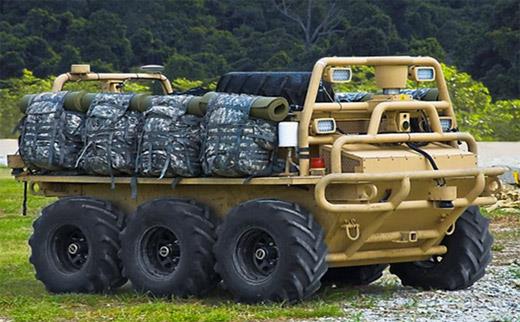
 
  • Project Workhorse: UGV program deploying in Afghanistan that involves a self-transportable utility platform in the form of the Army sponsored Squad Mission Support System (SMSS) from Lockheed Martin. The SMSS is an autonomous ground vehicle that can carry up to a half-ton of squad equipment and can be remotely operated via satellite to perform autonomous operations such as follow-me, go-to-point and retro-traverse. The SMSS sensor suite integrates Light Detection And Ranging (LIDAR), infrared (IR) and a color camera. The vehicle can lock-on and follow any person by identifying his 3D profile captured by the onboard sensors. The SMSS can autonomously navigate through a pre-programmed route using GPS waypoints. Evolution of this class of UGV will require improvements in onboard computer power consumption and more and better sensor integration, while also providing equal or higher computes with a reduced detectable emission signature (See Figure 1).

Figure 1. Lockheed Martin's SMSS, currently deployed in Afghanistan.
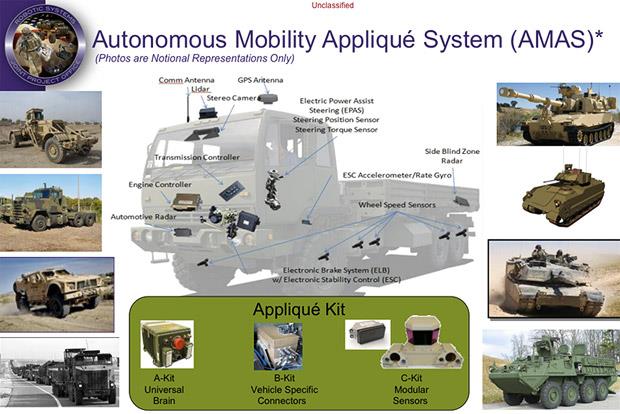
  • Convoy Active Safety Technology (CAST): Autonomous Mobility Applique System (AMAS) in the form of an add-on or appliqué retrofit kit to virtually any existing manned vehicle, permitting a wide range of autonomous behavior. Capabilities range from remote operation to driver assist to fully autonomous driving and navigation. The AMAS will be produced using a common open architecture and delivered in multi-kit form: an “A-Kit,” which is the universal brain; a “B-Kit,” which contains the vehicle-specific sensors, aggregation and connectors; and the “C-Kit,” which is oriented toward payload management. With the AMAS, more processing means more autonomous capability; to meet the scale of expected demand, the kits should be delivered in a smaller, standard footprint and take advantage of standardized connections, lowering system costs (See Figure 2).

Figure 2. Examples of how the AMAS kits can be used in a variety of military vehicles to promote varying levels of autonomy.

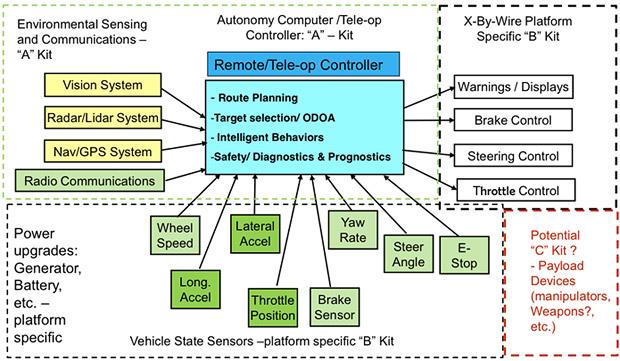
A common need across programs is the function of autonomous operation and payload support. For the AMAS technology illustrated in Figure 3, autonomous operation is achieved using a combination of multiple sensors, onboard processing, drive-by-wire functionality and additional payload control.
While these programs are currently underway, the Army's RS JPO technology roadmap demands enhanced capabilities for future revisions of these programs that support the following:

 
  • Integration of higher definition IR cameras, more onboard image enhancement for visible spectrum cameras, future integration of both visible and IR data in real time, more camera/sensor inputs that can support higher bandwidth.
  • Algorithm support for object detection and avoidance, intelligent object detection and tracking, stereographic imaging and processing (eventually reaching object identification).
  • HPEC computing support for the above, along with integration of multi-sensor payloads such as IED detection, weapons management, manipulators and sensor cross-cueing.
  • Future common, standards-based architecture for UGV computing (per the RS JPO and its Interoperability Initiative - currently at IOP v.0).
 

For UGVs to achieve improved autonomous operation, the technology roadmap calls for progress in sensor capabilities in terms of input speed, multiple sensor data aggregation, real-time data processing and results dissemination to the controller subsystems. With the sensor requirements and payload-specific support, such as side-looking radar for IED detection, the demand on a single HPEC solution is great. In addition, the push for open standards across the entire scope of product architecture will drive adoption of less proprietary physical hardware, connectivity and software solutions, thus creating the potential for more competitive, interchangeable and evolutionary options.

Imaging and Payload Technology Drives HPEC Requirements in UGVs


Computing requirements in UGVs are being driven by imaging used in support of machine vision and the advent of complex payloads for IED detection. There are military UGV programs that need an ability to perform autonomous navigation during the day, as well as the night. They require the ability to navigate in stealth mode (where perception sensor energy is not emitted). Using a pair of Thermal Infrared (TIR) cameras, stereo ranging and terrain classification can be performed to generate an annotated map of the terrain. TIR is a convenient option, since a single TIR camera may already be a part of the sensor suite of many vehicles. A HPEC is provided to analyze the thermal image data and perform the terrain mapping2.


For the evolution of autonomous operation relying on TIR offered in UGVs, the image processing that is critical to control functions like autonomous navigation will need to increase as the sensor data streams increase. To achieve useful machine vision, a camera sensor fusion will likely include IR, color CCD and LIDAR capability in a single turret3. Each of these cameras will operate between 15 to 60 fps and can today generate uncompressed 516 Mbits/second of image data per camera, growing to 1.3 Gbits/second and finally 3.48 Gbits/second. Camera data might not be compressed at the source, so as not to degrade the level of image processing that can be rendered by the HPEC interfaced using the RS-170 or RS-422 video signal standard. As data rates increase, CameraLink, GigEVision or CoaXpress will replace the above interfaces.


The RS JPO roadmap calls for new obstacle and collision avoidance algorithms, which rely heavily on recursive calculations best done on GP-GPUs or specialized FPGAs. For example, recent research done for UAV image processing using GP-GPU based algorithms4 has shown a 99.5% increase in performance over running the same algorithm on an Intel CPU. In all cases, the GP-GPU rendered the results in under 50 msec4. Given a fully autonomous vehicle scenario where a human operator is not involved, and vehicle operation decisions must be made in real-time at speed; having an HPEC equipped with GP-GPU capability that can correlate all the inputs and successfully execute the mission is imperative. Hence the use of multiple types of higher definition cameras running at a higher resolution; higher bandwidth will drive the design of rugged HPEC computing that supports future UGVs.


A complete anti-IED payload system requires an IED-detection component, an IED-assessment component and an IED-defeat component. The payload processing must be accomplished in real-time to achieve the desired level of safety for the UGV and its mission. As with autonomous navigation and machine vision, the real-time detection of the changes in the data coming from the detector components will require a large amount of either GP-GPU or FPGA processing.


Today, a divide and conquer approach is used to separate vehicle control, sensors and payload processing. Separating functions into kits as described with AMAS technology (See Figure 4) is a good approach to the future growth of HPEC in UGVs. For example, a fully autonomous vehicle with a payload of ground penetrating radar could not execute all of its processing tasks with a single HPEC solution. By sub-dividing the problem into compute and function nodes, a scalable long-term solution emerges. Having standards for the UGV solutions that regularize the HPEC physical box size, supported I/O and connector types will enable interchangeability and evolution as HPEC solutions grow and change.

Evolution of Technology Standards, COTS and Engineering Innovation


Evolving UGV requirements need raw processing speed and execute algorithms that are highly recursive, creating the need to have HPEC solutions that combine generic COTS Intel CPU processing and a closely coupled GP-GPU into a single solution.


As mentioned, the RS JPO is promoting the use of standards in the fielding of UGV solutions, current market 3U & 6U VPX provide rugged HPEC solutions. Emerging standards in smaller footprint HPEC solutions include the VITA Technologies standard known as VITA 75. VITA 75 takes a fundamentally different approach from other small form factor standards, in that it concentrates on the physical box, a set of standard enclosures dimensions, connectors and I/O pin assignments, rather than on specifying the individual computer modules inside.


VITA 75 subsystem profiles are composed of up to four separate sub-profiles:

 
  • VITA 75.0 component of subsystem profile (base profile)
  • VITA 75.11 component of subsystem profile (front panel profile)
  • VITA 75.2x cooling and mounting, consisting of a VITA 75.2x dot specification followed by profile nomenclature specified by VITA 75.2x
 

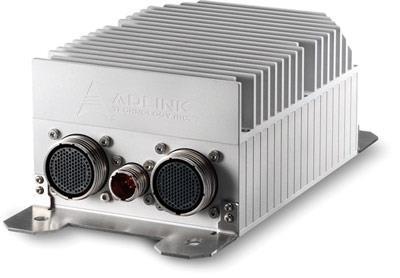
VITA 75 solutions are especially well-suited to address UGV HPEC requirements, as they provide designers with a set of standardized footprints that are generally smaller than equivalently equipped OpenVPX 3U or 6U solutions, while also offering a standardized connector scheme that allows for sub-system interchangeability at the vehicle-level and provides for evolution of the vehicles sub-system in a predictable fashion. ADLINK's HPERC (High Performance Extreme Rugged Computer) system is typical of this type of VITA 75 solution (See Figure 5). HPERC provides a solid foundation of Intel i7 processing closely coupled to either an embedded NVIDIA or ATI GP-GPU, as well as a wealth of camera and vehicle data bus and I/O support. This solution can readily provide the necessary image processing and I/O required for UGV applications both today and in the future.

Link

Figure 5: The ADLINK HPERC is a sealed, rugged COTS computing platform incorporating industry standard technology and long-life processing architecture.

Summary


UGVs represent a force multiplier for ground forces. The challenges of true autonomous operation and adequate payload support represent a clear direction for HPEC. If the aggressive roadmap for UGVs is to be realized, a common, standards-based HPEC architecture must emerge and evolve. ADLINK, along with fellow embedded platform vendors, is working to define and develop against industry standards in order to meet the SWaP requirements for HPEC systems of the future in order to meet the demanding requirements of UGV and other programs that benefit the warfighter.


Citations:

 
  1. Robotic Systems – Joint Project Roadmap - 2011 and addendum 2012. Unmanned ground systems discussed include CAST/AMAS, Packbot 500 Fastac, SUGV XM-1216 w/Tether, SUGV 310 (Mini-EOD), TALON III B, TALONG IV, and Packbot 510.
  2. A. Rankin - Unmanned ground vehicle perception using thermal infrared cameras - 2011
  3. G. Kogut - Sensor Fusion for Intelligent Behavior on Small Unmanned Ground Vehicles 2007
  4. B. I. Sheta - Vision based Navigation (VBN) of Unmanned Aerial Vehicles (UAV) - 2012
COTS Conduction Cooled CompactPCI for Military Applications 리스트 VITA 75 vs. VPX: Optimizing unmanned vehicle thermal and payload efficiencies
  • 회사 정보
  • 미션&비전
  • 사회 책임 정책
  • 뉴스 & 이벤트
연락처
전세계 오피스
구매처
고객 지원
기술 문의
파트너 센터
eRMA서비스
  • 소셜 네트워크
개인정보 보호정책
쿠키 정책
사이트 맵
회사 소개전 세계 사무소고객 지원
Copyright © 2025 ADLINK Technology Inc. All Rights Reserved.
Email:info@adlinktech.com