Chris Ni, Product Manager,
ADLINK Technology Inc.
|
As widely deployed in various applications, PXI has been well-recognized as a proven platform for testing and measurement. It delivers a reliable mechanical frame and forced-air cooling, as well as bus signals that match requirements for inter-module synchronization. Typically, a PXI system is composed of a chassis, a controller, and functional modules. Though the PXI chassis is usually considered a low complexity component, it is an important part in delivering a reliable environment for system operation. For years, ADLINK Technology has provided a variety of PXI chassis for various PXI-based applications, from 6-slot to 18-slot, 3U to 6U, and bench-top to rack-mount systems; and we have gotten tremendous customer feedback on usability to understand exactly what our customers want from a PXI chassis.
In this article, we will present several frequently encountered customer requirements and how they inspired us when designing our new PXI chassis.
Portability
For a rack-mount chassis, portability is not a concern. But for a bench-top PXI chassis, sometimes users need portability to carry out measurement tasks. For these usages portability comes from two major factors: integration of user-interface devices and weight.
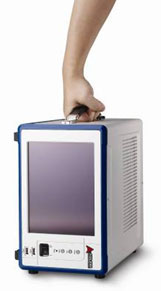
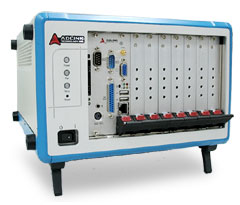
Typically, a PXI chassis contains only a PXI controller and several PXI modules, requiring additional peripherals such as a monitor and keyboard/mouse to operate the PXI system. If you need to operate the chassis in a remote location, you would need to carry those user-interface devices with your PXI system. This significantly limits the portability of the PXI system. Fortunately, PXI specification Rev. 2.2 allows the use of 64-bit PCI signals [AD32:63] on the J2 connector for the implementation of a rear I/O system controller. This revision allows ADLINK to implement a rear I/O module inside the chassis for the interconnection of signals, such as video, USB, and COM. When we designed our new PXI chassis, we integrated an 8.4" LCD touch panel into the chassis and wired all cables within the chassis. What users get is a simple and clean PXI chassis with a built-in LCD display that supports 800 x 600 resolution and touch panel interface. The built-in display allows a certain level of portability to users since they can easily build a stand-alone measurement system and perform testing and measurement jobs anywhere they need, without the burden of an external monitor or keyboard/mouse.
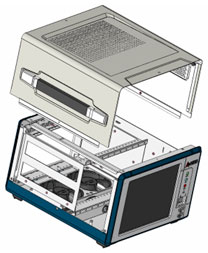
Weight is another limitation of portability. Our customers expect light weight chassis without sacrificing robustness. These requirements lead us to rethink our chassis materials and combine two light weight metals to build the chassis frame. We used aluminum for the chassis frame to reduce overall weight, and metal for the chassis shell to provide rigidity and strength. The result is the lightest 8-slot bench-top PXI chassis on the market with superior structural robustness.
Chassis Management
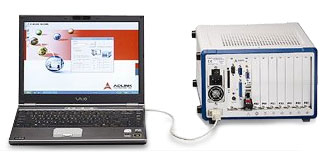
When we engaged an accelerator project where our customer needed to deploy many PXI platforms over a large geographical area, our customer proposed a requirement for monitoring the chassis status so that any failure of fans or power supply could be detected. This gave us the inspiration to design a specific chassis control board for our new PXI chassis. The control board continuously senses the chassis status, including DC voltages, fan speeds and internal temperature. Once an abnormal condition is detected, the control board generates an alarm through blinking LED indicators and actuating a buzzer. In addition, the control board is capable of exporting the chassis status to a remote computer via a standard RS-232 port, as well as allowing a remote computer to control the power on/off the chassis through software commands.
Through embedding this control board, our new chassis can not only monitor its status internally but also allows remote monitoring and control. This feature makes distributed PXI systems feasible.
Thermal Stability
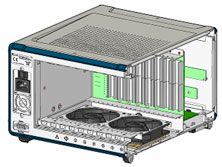
Maintaining a stable temperature inside the chassis is always a major concern for the operation of a PXI system. Thermal stability considerably relies on mechanical design for effective heat dispersion, including the selection of fans, position of fans and inlet/outlet apertures. We placed two 60CFM fans on the bottom of the chassis, as bottom-top convection allows increased effectiveness for airflow. Because our PXI system was designed with extremely harsh environments in mind, we tested it by configuring a 3U PXI resistor board that consumes 30 watts of power. We also installed seven resistor boards into the peripheral slots, for a total of 210 watts which generated relatively high heat that was dispersed in the chassis. Then we put the chassis in a 50�XC chamber for extended temperature testing. The results showed that the internal temperature remained stable throughout operation regardless of the high heat generated.
Acoustic Noise
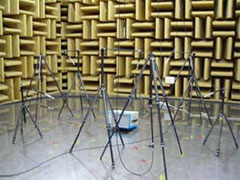
For a bench-top PXI chassis, noise is another unwelcome characteristic. "Low noise" usually contradicts "high cooling performance" since cooling fans are the major source of noise emission. We balanced the tradeoff by allowing the speed of the cooling fans to be controlled by the control board according to the input temperature sensors. While the chassis is placed at room temperature, the fans operate at a low speed, and the acoustic emission is as low as 41.6 dBA (sound pressure level, measured at operator position). The automatic fan speed control function helped us to design a PXI chassis that gives consideration to both quiet operation and a wide temperature range.
Appearance
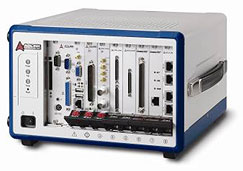
In the very beginning of the evolution of PXI, it was primarily considered a hybrid testing system. Recently, PXI has taken a more important role. Customers use PXI platforms as the core to build upon testing and measurement equipment. This is one of the reasons we were asked to give our PXI chassis an instrument-like look. Our industrial design team and mechanical engineers were involved in the early stages to make sure that the chassis had a professional look and reliable structure.
The PXI chassis is a simple yet essential part of a quality PXI system. With the wide spread of PXI-based applications, PXI chassis hold great promise to be deployed in a variety of environments. By leveraging new ideas and technologies in design, next-generation PXI chassis will be more reliable, smarter and quieter, and will be ready for any kind of PXI application.
 BACK BACK
Related ADLINK Links:
ADLINK Measurement & Automation
ADLINK Smart PXI interactive demo
|




